When I first started this course, I thought of writing as something that belonged mostly to English and humanities classes. As a Computer Science major, I have always been more comfortable thinking about programming, algorithms, problem-solving, and finding solutions to technical problems. I understood that writing was important, but I did not always think of writing as an essential part of computer science. Over the course of this summer, however, that perspective changed. Through my projects, blog posts, revisions, research, and reflections, I learned that being a successful computer scientist requires much more than knowing how to code. It also requires being able to explain complicated ideas, communicate with different audiences, research responsibly, revise ideas, and make technical information understandable.
This portfolio represents that progression. Rather than looking at my projects as individual assignments, I see them as steps in learning how to communicate more effectively. My earlier work focused more on completing the assignment, while my revised work focused more on the audience, purpose, organization, and overall message. Looking back at my work now, I can see that revision was not simply correcting grammar or changing a few sentences. Revision meant reconsidering what I was trying to communicate and asking whether someone else would actually understand why the topic mattered.
Revising and Expanding My Projects
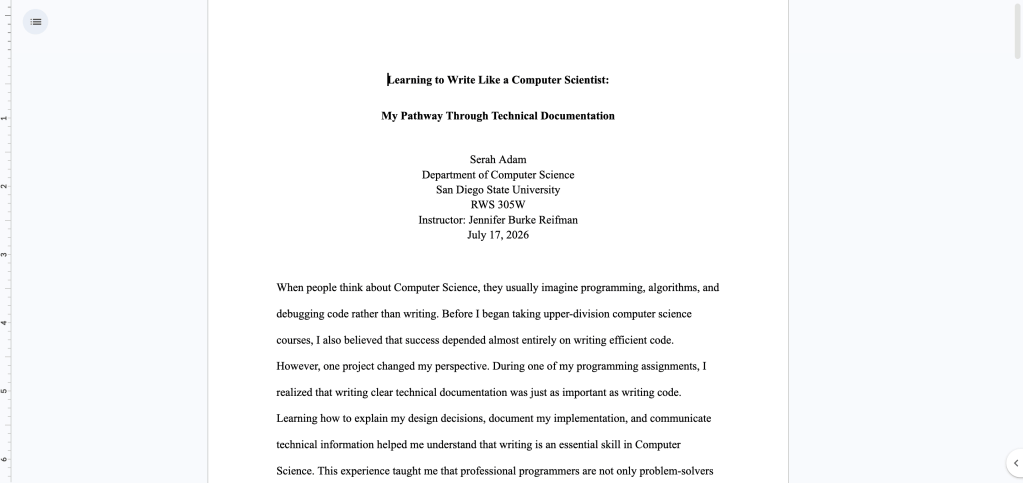
One of the most important things I learned this summer was that a first draft is not necessarily the final version of an idea. My projects changed as I became more aware of my audience and purpose. For example, in my Project 1, I initially approached the assignment mainly by focusing on what I needed to include. As I revised it, I began thinking more about how a reader would move through the information.
The biggest improvement was organization. Instead of assuming that the reader already understood what I meant, I worked on providing more context and creating clearer connections between my ideas. I also became more aware of transitions. In my earlier writing, I sometimes moved from one idea to another because the connection made sense to me. Revision taught me that a connection that seems obvious to the writer might not be obvious to the reader.
The feedback and expectations from the course informed many of these changes. I started paying attention not only to whether I had answered a prompt but also to whether my writing actually accomplished its purpose. I asked myself questions such as: Who is reading this? What do they already know? What information do they need? Why should they care?
My Project 2 gave me another opportunity to practice this. This project pushed me to think more seriously about writing within my discipline. Computer Science writing is often associated with technical documentation, research papers, project proposals, documentation, and reports. These genres are different from a traditional academic essay because they usually have a very specific purpose. A technical writer is not simply trying to sound intelligent. They are trying to help someone understand, make a decision, solve a problem, or use a system.
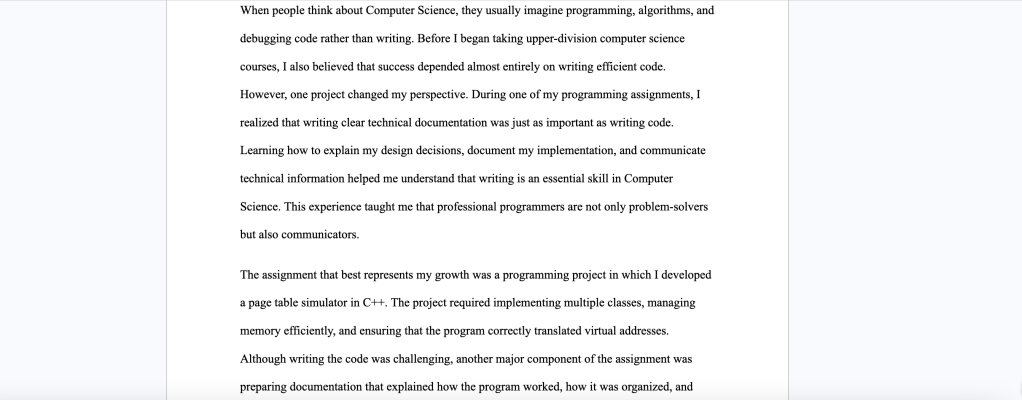
When I compare my earlier version with my revised version, I notice that my writing became more intentional. I paid closer attention to introductions, evidence, explanations, and conclusions. I also learned that adding information is not always the best form of revision. Sometimes removing unnecessary information makes an argument stronger.
My Project 3 continued this process. This project helped me understand that writing can change depending on the audience. A person who works in Computer Science may understand terms such as artificial intelligence, algorithms, machine learning, or cybersecurity without much explanation. A general audience may not. If I am writing for the public, I cannot assume that everyone has the same technical background that I do.
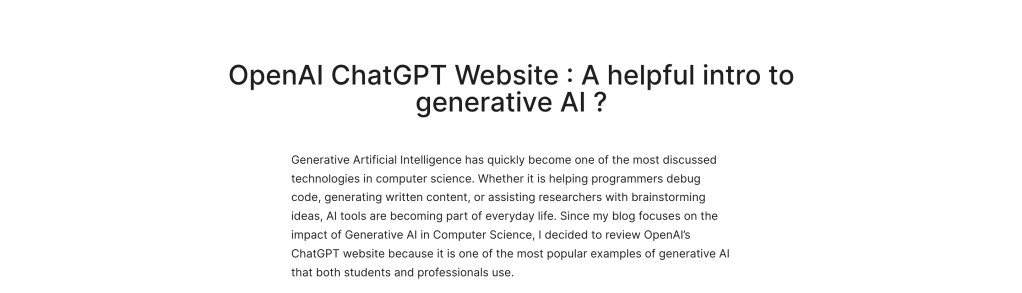
That became especially important when I worked on my blog posts about Open AI and Computer Science. My OpenAI ChatGPT Blog allowed me to take a technical and professional issue and discuss it in a way that could be understood by people outside of Computer Science.
Building a Portfolio Instead of Just Completing Assignments
Another thing I learned is that a portfolio is different from a collection of assignments. A collection simply shows what someone completed. A portfolio can show how someone developed.
Someone using my portfolio should not just click through the projects randomly. Instead, I would encourage them to look at the projects chronologically and compare my earlier work with my later work. They can look at my Project 1, then my Project 2, and finally my Project 3 to see how my writing and approach changed.
I would also recommend looking at my blog posts because they show a different side of my writing. My Blog Post 1 demonstrates how I began thinking about my field and its relationship with the public. My Blog Post 2 shows how I experimented with communicating information through a more informal and accessible format.
The resources in my portfolio are meant to show that communication in Computer Science does not always look like code. A successful computer scientist may write documentation, emails, proposals, research papers, project reports, instructions, presentations, blog posts, and explanations for users. Each one requires a different approach.

What Makes a Successful Writer in Computer Science?
Before this course, I probably would have said that a successful writer in Computer Science is someone who can write clearly and avoid grammatical mistakes. I still think clarity matters, but I now understand that successful technical writing requires much more.
A successful writer in Computer Science needs to understand audience, purpose, organization, accuracy, and accessibility.
Audience is important because technical knowledge varies. A software engineer, a professor, a manager, and a person using an application may all need different explanations of the same technology.
Purpose is equally important. A technical report is not written for the same reason as a blog post. A project proposal may need to persuade someone to approve an idea, while documentation needs to explain how something works.
Accuracy is especially important in Computer Science because incorrect information can lead to incorrect decisions or working systems that do not work as intended. At the same time, accuracy does not mean using complicated language simply to sound professional.
One of the biggest lessons I learned is that good technical writing makes complicated information easier to understand without making it less accurate.
That is something I want to carry with me into my future career.
What My Resources Can Teach Someone Else
The resources I created can teach someone that Computer Science is not isolated from society. Technology affects communication, education, employment, privacy, security, and everyday life. My writing about Generative AI especially helped me recognize how quickly technology can move from being a technical concept to something that affects ordinary people.
Someone reading my portfolio who is not a Computer Science major might learn that AI is not simply a tool that produces answers. It raises questions about authorship, education, creativity, employment, reliability, and responsibility. At the same time, someone interested in Computer Science might learn that technical knowledge alone is not enough. We need to understand the social effects of the technologies we create.
My blog also gives a general audience an opportunity to see Computer Science from a student’s perspective. Instead of only hearing from large technology companies or professional researchers, readers can see how a student preparing to enter the field thinks about these issues.
What I Learned About Reading and Writing in My Field
This summer changed the way I think about reading as much as it changed how I think about writing.
I learned that reading in Computer Science is often active reading. When reading technical information, I cannot always read every sentence in exactly the same way. I need to identify the purpose of the document, locate important information, recognize terminology, and determine what information is actually useful.
The assignments involving genre were particularly important because they showed me that different forms of writing have different expectations. Looking at professional genres helped me realize that writing is shaped by the situation in which it is being used.
The blog assignments also stuck with me because they required me to step away from the traditional academic essay. Instead of writing only for my instructor, I had to imagine a broader audience. I had to think about what would make someone want to continue reading. Images, hyperlinks, headings, spacing, and tone suddenly became important parts of the writing.
That helped me realize that communication is not just about the words on the page. Form is part of the message.
A reader’s experience can change depending on how information is organized and presented.
What I Learned About Myself as a Writer
One of the biggest things I learned about myself is that I tend to focus heavily on getting my ideas down before thinking about how someone else will receive them. This can be helpful because it allows me to get started instead of overthinking every sentence. However, it can also make my first drafts less organized.
Revision helped me recognize this pattern.
I also learned that I am capable of writing about technical topics for audiences who may not have a technical background. Before this course, I might have assumed that writing about Computer Science meant using technical vocabulary. Now I understand that being able to explain an idea simply is actually a sign that I understand it well.
If I cannot explain a concept without relying on complicated terminology, I may not understand the concept as well as I think I do.
I also became more comfortable with writing in my own voice. Academic writing can sometimes feel like it requires a very formal personality. The blog assignments showed me that professionalism and personality can exist at the same time.

How This Will Help Me in the Future
These skills will be useful to me both as a student and as a future professional. As I continue studying Computer Science, I will have to write research papers, project documentation, reports, proposals, and technical explanations. If I continue into graduate school, communication will become even more important because I may have to explain research to professors, classmates, researchers, and eventually a broader public.
If I enter the technology industry, these skills will be just as valuable. Software developers and other technology professionals communicate constantly. They write documentation, contribute to project reports, communicate with coworkers, explain technical problems, create presentations, and interact with people who may not have the same technical knowledge.
Whether I eventually work at a technology company, continue into graduate school, or pursue a career that combines Computer Science and communication, writing will remain part of what I do.
Looking back at this portfolio, I can see that I did more than complete several assignments. I learned how to think about writing as a form of problem-solving. In programming, I identify a problem, develop a solution, test it, find weaknesses, and revise it. Writing is surprisingly similar. I begin with an idea, communicate it, look for weaknesses, receive feedback, and revise it.
That connection between programming and writing is probably one of the most important things I will take away from this course.
Final Reflection
At the beginning of the summer, I viewed writing as something separate from my future in Computer Science. Now I see writing as one of the tools that will help me succeed in that future.
My projects show a progression from simply completing assignments to thinking more carefully about audience, purpose, genre, evidence, organization, and presentation. My blog posts helped me become more comfortable writing for a general audience, while my genre work showed me how professional communication works within a discipline.
Most importantly, I learned that good writing is not about making something sound complicated. It is about making an idea understandable, meaningful, and useful to another person.
That is something I want my portfolio to communicate. A reader should leave this portfolio understanding not only what I wrote, but also how my writing changed. They should be able to see the revisions, recognize the lessons behind them, and understand how those lessons connect to Computer Science.
As I move forward in my education and eventually into my career, I know that I will continue learning how to write. My writing will probably change depending on whether I am communicating with a professor, a programmer, a manager, a client, or the general public. But the main lesson I am taking with me is simple: knowing something is only part of being successful. Being able to communicate what you know is just as important.
This portfolio is a reflection of that realization and of the progress I made throughout the summer.
 sadam3994-frnkc
Leave a comment